
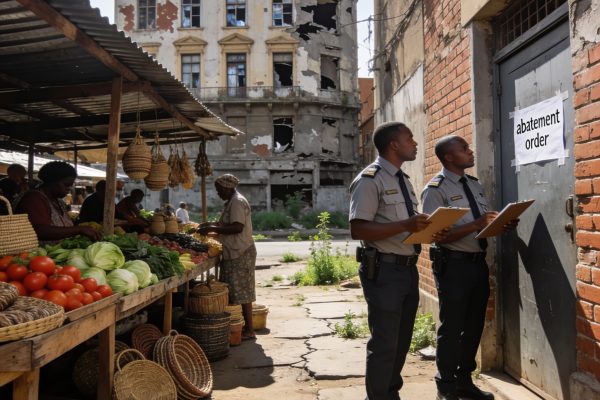
HARARE — Zimbabwe’s urban clean-up campaign moved into a tougher phase on Thursday, 17 September, with the government announcing fresh trading curfews for informal vendors, directing all local authorities to act against run-down properties and making clear that the push against undesignated trading will not be a short-term operation.
Local Government and Public Works Minister Daniel Garwe told journalists in the capital that the removal of vendors and hawkers operating outside approved sites would continue indefinitely, running alongside stricter enforcement of building and property regulations. He insisted the objective was not to shut down livelihoods, but to make sure informal trading happens in a lawful, orderly and safe manner.
New trading window for vendors
Under the revised rules, trading inside central business districts is now confined to the hours between 6am and 6pm, while vendors operating in residential areas, including high-density suburbs, must close by 8pm. Permanent Secretary in the ministry, Engineer Tafadzwa Muguti, said the restrictions took effect immediately across all 92 local authorities and were not aimed at any single city or category of trader.
“After 6pm, we do not expect to see anyone doing vending within any business district. And after 8pm, we do not expect to see any vending within residential communities,” Muguti said, adding that the hours would generally align with existing licensing conditions unless a specific permit states otherwise.
The change carries particular weight in Bulawayo, where the city centre and surrounding suburbs have long served as busy trading grounds for sellers of fresh produce, clothing, cooked food and household goods. Traders who depend on the late-afternoon and early-evening rush, when commuters head home, are likely to feel the pinch most sharply.
Muguti said 113 municipal by-laws are being reworked to bring them into line with the country’s Vision 2030 development agenda, and signalled that a renewed National Cleanup Campaign would soon move into neighbourhoods countrywide.
Abatement orders for dilapidated buildings
The same clean-up drive is being turned on property owners. Garwe directed local authorities to begin issuing abatement orders against owners and occupiers whose buildings, boundary walls, pavements, yards and surrounding areas are unsafe, unsanitary or visibly neglected.
He cited Section 36, Subsection 4 of the Housing Standards Control Act, saying the directive had immediate effect across all 92 local authorities and covered shopping centres, business complexes, industrial sites, offices, churches and homes. Affected owners will be required to repair, renovate, repaint and clean their premises to bring them up to standard.
An abatement order is a legal instruction compelling a property owner or occupier to fix specified problems within a period set by law. Non-compliance can attract penalties including a fine of up to level five, imprisonment of up to six months, or a bond, depending on the legislation applied.
Illegal construction in the crosshairs
Local planning authorities have also been told to tighten enforcement against unapproved construction and unauthorised building modifications. Where illegal developments are identified, enforcement orders will be issued requiring those responsible to stop work or remedy the breach.
Garwe said old vending sites must be renovated so they are safe and fit for use, and confirmed that amended Hawkers and Vendors By-Laws are being prepared to introduce updated licensing and control measures, including rules covering third-party-owned trading sites.
In Harare, he singled out the Central Business District for special attention, describing First Street and the downtown area as a gateway and commercial corridor that should reflect the standing of the capital.
Livelihoods versus regulation
The government framed the programme as an ongoing cycle of restoration, enforcement, rehabilitation and improved service delivery, rather than a single sweep. Garwe called on property owners, businesses, vendors and residents to cooperate with councils, and said the effort would eventually reach growth points in rural districts.
Enforcement details remain vague, however. Authorities have yet to spell out how the new trading hours will be policed or what penalties traders who breach them will face — a gap likely to fuel anxiety among informal workers who rely on street trading in an economy where formal jobs remain scarce.
Vending restrictions have repeatedly proved a delicate balancing act for Zimbabwean municipalities, which face pressure to decongest city centres and improve waste management while thousands of families depend on the informal economy for daily income. How the latest measures are implemented in the coming weeks will determine whether the clean-up is seen as urban renewal or as another blow to struggling traders.