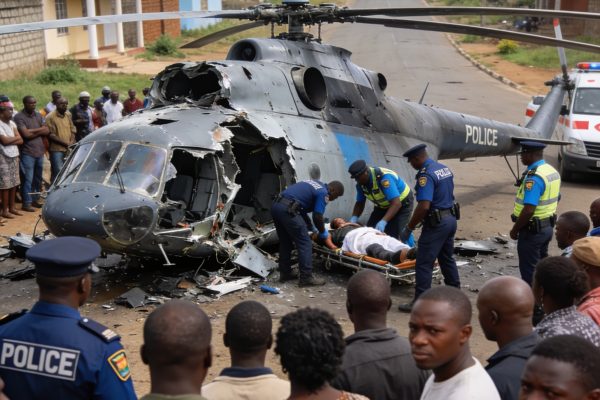
HARARE — Zimbabwe woke up to a dramatic and polarizing narrative this Thursday following the fatal helicopter crash that claimed the life of Wicknell Chivayo, one of the country’s most controversial business figures. Chivayo, his wife Lucy “Lulu” Muteke, two pilots, and a security aide were among six occupants who perished on Wednesday evening when their aircraft crashed and caught fire in the rural Marondera area, about 75 kilometers northeast of Harare.
The incident has triggered a stark contrast in reactions, highlighting the deep societal fault lines Chivayo navigated during his lifetime. On the international stage, Kenyan President William Ruto joined a small circle of high-profile figures in mourning the loss. Ruto described Chivayo as a “dear friend” and a “warm personality,” praising his energy and conviction in Africa’s potential.
“I am deeply saddened by the tragic passing of my friend, Wicknell Chivayo, together with his wife, Lucy Muteke, and the other lives lost in the helicopter crash in Zimbabwe,” Ruto stated. “Their sudden departure is a painful loss to their families, friends and all who knew them.”
Ruto’s tribute underscores Chivayo’s extensive regional networking, which often saw the businessman sharing photographs with heads of state including Eswatini’s King Mswati III and Tanzanian President Samia Suluhu Hassan. Chivayo’s public persona was inextricably linked to the ruling Zanu PF party and its inner circles, a relationship that fueled both his business opportunities and the public’s skepticism.
A Nation Split Between Mourning and Relief
Inside Zimbabwe, however, the mood was far more complex. State media initially reported that the nation had been “plunged into mourning,” but social media and street-level conversations painted a different picture. A significant segment of the population, weary of the opulence displayed by Chivayo amidst an economic downturn, reacted with celebration rather than grief.
Chivayo had recently adopted the biblical title “Mukuru Wemazuva” (The Ancient of Days), a move that was interpreted by many religious citizens as blasphemous hubris. This, combined with his publicized donations of luxury cars and cash to loyalists, created a backlash that persisted even after his death.
“There’s a saying in Shona: “Mabasa ako anokutevera” — what you’re seeing now is just someone’s work following them,” commented Pablo Chimusoro, reflecting a sentiment shared by many who viewed his wealth as disconnected from genuine national contribution.
Many Zimbabweans pointed to the unfulfilled promises associated with Chivayo’s ventures, particularly the stalled Gwanda Solar Project, a tender he won years ago but never successfully delivered. Critics argued that his influence and wealth were products of a system they viewed as exploitative, leading to a sense of resignation rather than sorrow among the working class.
The Crash Site and Ongoing Investigations
While the ideological debate rages, the immediate focus of authorities remains the accident itself. Police confirmed the crash at 5 PM local time on Wednesday, describing a chaotic scene as emergency services raced 74 kilometers from Harare to the rural Marondera site. The crash site was reportedly difficult to access, and the fire that engulfed the helicopter left little of the fuselage intact.
The Zimbabwe Republic Police (ZRP) stated that details regarding the cause of the accident would be released “in due course” as the scene was being attended to. Questions have also emerged regarding the availability of emergency medical services in the area, with reports of long response times raising concerns about infrastructure gaps in rural provinces.
Chivayo was flying from a private property in Marondera toward the capital when the accident occurred. He leaves behind a legacy defined by extreme visibility, high-level political connections, and a business model that often blurred the lines between private enterprise and state influence.
What’s Next?
As the investigation into the mechanical or environmental factors leading to the crash continues, the conversation in Zimbabwe remains less about aviation safety and more about accountability and the culture of wealth accumulation. For President Ruto and Chivayo’s other regional allies, the event is a personal loss; for many of Chivayo’s domestic critics, it is a chapter closing with an exclamation mark on a life lived loudly.