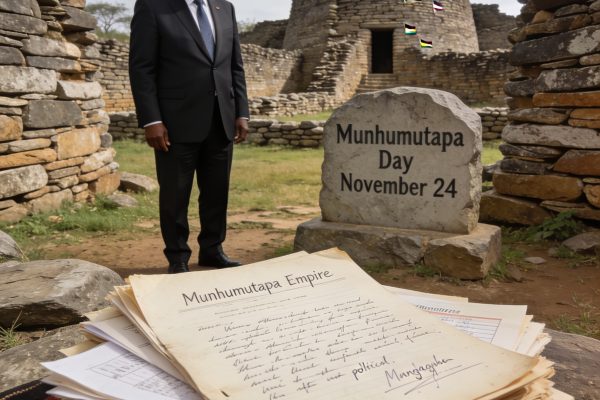
The recent declaration of September 15 as Munhumutapa Day, a new public holiday honouring the ancient Munhumutapa Empire, has sparked a heated national debate over historical accuracy and political symbolism.
The controversy deepened after Minister of Lands, Agriculture, Fisheries, Water and Rural Development, Anxious Masuka, told an audience at Pricabe Farm that the date’s alignment with President Emmerson Mnangagwa’s birthday was a “mere coincidence.”
But critics have dismissed this explanation as implausible, pointing out that the holiday was established through Statutory Instrument 148 of 2026, signed by President Mnangagwa himself. They argue that the date was deliberately chosen to coincide with the President’s birthday, raising questions about the true motivation behind the holiday.
Social justice advocate and writer Tendai Ruben Mbofana, in a sharp critique, described the coincidence claim as “political gaslighting.” He noted that prior to the proclamation, September 15 had no historical, astronomical, or cultural connection to the Munhumutapa Empire. “A coincidence occurs when a child happens to be born on Christmas Day,” Mbofana wrote. “It is not a coincidence when you draw a bullseye around where your own dart landed.”
Mbofana suggested alternative dates rooted in documented history, such as November 14, 1693, when Munhumutapa Nyakunembire and Changamire Dombo destroyed Dambarare and expelled foreign occupiers, or August 1631, when Munhumutapa Kapararidze led a major revolution recorded by Portuguese sources.
The historical debate has also drawn in Zanu-PF Youth League leader John Paradza, who recently claimed that the Mutapa Empire built Great Zimbabwe. Historians and archaeologists have rejected this assertion, noting that Great Zimbabwe reached its peak between the 11th and 14th centuries, while the Mutapa state was founded around 1430 CE, after Great Zimbabwe had already begun to decline.
Mbofana argued in a separate article that such claims distort the timeline and erase the distinct identities of pre-colonial societies. He explained that the founder of the Mutapa state, Nyatsimba Mutota, migrated north to the Dande and Zambezi Valley in search of salt and new trade routes, integrating with indigenous communities rather than transplanting Great Zimbabwe.
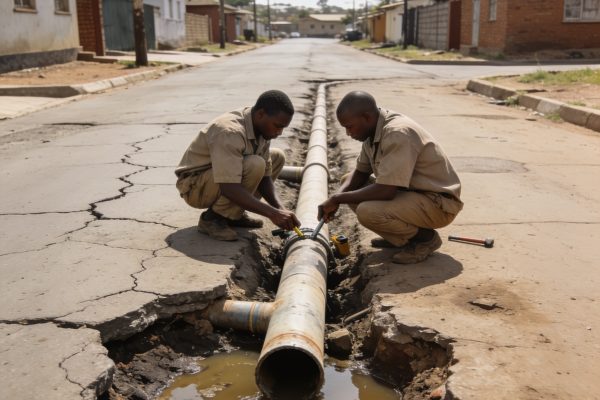
Critics see the Munhumutapa Day declaration as part of a broader pattern of historical revisionism aimed at bolstering the current administration’s legitimacy. They point to Zimbabwe’s ongoing economic crisis, crumbling infrastructure, and widespread poverty, arguing that wrapping a failing government in the robes of ancient kings does little to improve ordinary people’s lives.
The government has not responded to the criticisms, but the controversy is unlikely to fade quickly. As Zimbabweans prepare for the first Munhumutapa Day holiday, questions remain about whether the nation is honouring its true heritage or a political myth.
Historian and social commentator Tendai Ruben Mbofana concluded: “True national pride is built on historical truth, not political mythology.”