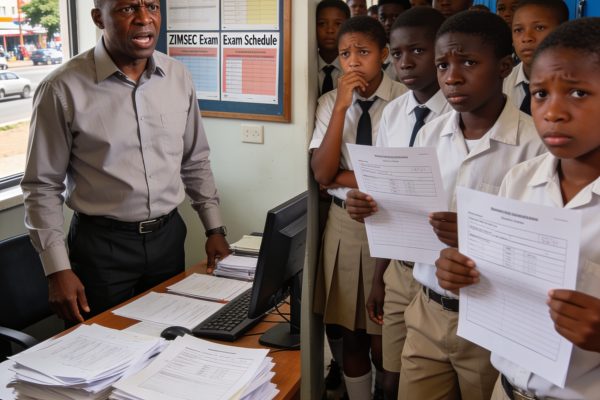
A Harare school principal has been arrested after examination fees paid by parents of dozens of Grade Seven candidates were allegedly never forwarded to the Zimbabwe School Examinations Council (ZIMSEC), leaving 41 learners without confirmed registration as this year’s national examinations got under way.
Rosemary Matunga, who heads Emirates Primary School in Retreat, Waterfalls, was detained by police following complaints from guardians whose children were due to write their papers. The examinations opened on Monday, 21 September.
How the shortfall came to light
According to reports circulating in the capital, the school does not hold its own examination centre number and had arranged for its candidates to be registered through Hatfield Primary School. When the registration window closed, payments had reportedly been processed for only six learners — leaving 41 others off the list.
The gap only became obvious once the examination period began, when candidates arrived expecting to write and could not be accounted for. Parents said they had settled the fees in full and that nobody at the school had warned them anything was wrong.
Families caught off guard
Guardians spent the opening days of the exams moving between school authorities and ZIMSEC officials in a bid to secure places for their children. Some, according to the accounts, were on the verge of demonstrating against the school’s proprietor, identified only as Mr Pereka, before examinations officials intervened to try to find a solution.
For families in Waterfalls, the disruption came after months of preparation, extra lessons and fee payments made in the belief that registration was complete.
Why the centre number counts
Every candidate who sits Grade Seven examinations in Zimbabwe must be attached to a registered examination centre. Schools that do not have their own centre number rely on an agreement with another centre willing to host their pupils — and that arrangement depends on the full candidate list and the corresponding fees being submitted correctly and on time.
When money is not passed on, the burden falls on learners who have completed seven years of primary schooling and have no way of knowing that their registration is incomplete until it is almost too late.
A recurring accountability headache
The Waterfalls case is not the first in which missing examination fees have threatened pupils’ chances at the end of the primary cycle. Similar incidents in recent years have strengthened calls for tighter oversight of how schools collect and transmit public examination payments, including official receipts, audited records and early verification by ZIMSEC and the Ministry of Primary and Secondary Education.
Education officials have repeatedly urged parents to demand receipts for every payment and to confirm registration directly with the examination centre rather than relying on assurances from school administrators.
What happens next
The principal is expected to appear in court once investigations are completed. In the meantime, the immediate priority for affected families is securing a way for the candidates to write their papers, with ZIMSEC reportedly working with the schools involved to determine whether the learners can be accommodated.
For parents across Harare, the episode is a reminder that the run-up to Grade Seven examinations is as much about administration as it is about revision — and that a receipt in hand is often the only proof that a child has actually been registered.