
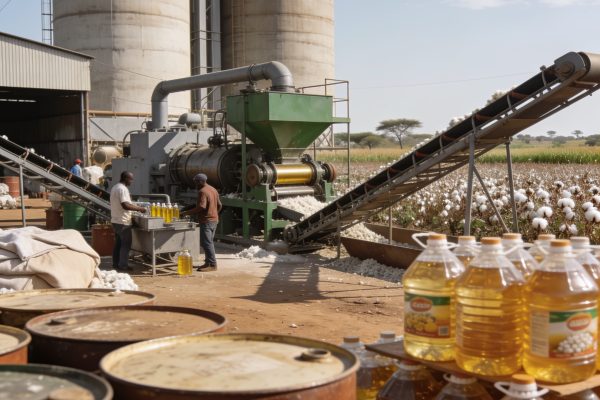
Gokwe, long celebrated as the heart of Zimbabwe’s cotton belt, is witnessing a quiet economic transformation. For decades, the fluffy white fibre known as ‘white gold’ dominated the industry, while the tiny brown seeds left after ginning were treated as little more than a by-product. Today, those seeds are being crushed into cooking oil, animal feed, and other goods, giving rise to a new rural economy.
At a processing plant in Nembudziya, about 72 kilometres from Gokwe’s business centre, the Cangrow Cotton Company (CCC) is leading this shift. Machinery hums as cottonseed is pressed into golden cooking oil, while the leftover material is converted into livestock feed and industrial by-products. Almost nothing goes to waste.
“Cottonseed is no longer a waste product. It has become an important raw material for cooking oil production, proving that every part of the cotton crop has value,” said CCC regional manager Khumbulani Moyo. “Through beneficiation, we are ensuring that what was once overlooked now contributes to the country’s food industry and the broader economy.”
Historically, Zimbabwe earned most of its cotton income from lint, while ginned seed was sold as a raw commodity. That model is changing. Processors are now looking beyond lint to capture more value after ginning. For Moyo, cooking oil is only the start. After oil extraction, the remaining cake becomes stock feed, soap, and other products. Every tonne processed locally supports activity beyond the factory walls: cooking oil reaches households, cotton cake feeds livestock, and by-products supply agriculture and manufacturing.
The process begins with farmers. Around Gokwe, ox-drawn carts and tractors deliver freshly picked seed cotton to buying points. Once, selling the crop marked the end of its local journey. Now, the emerging processing industry offers a chance to retain more value in the region. Small-scale farmer Tina Murabinda welcomes the development. “If cotton seed is processed into cooking oil and other products, it gives us another source of income and encourages more people to continue growing cotton,” she said.
However, not all growers are convinced they are benefiting fairly. Marry Chisvo, another small-scale farmer from Gokwe South, notes that while she is paid for her harvest, the real value lies further down the chain. “The biggest share of the value comes after the cotton leaves our hands, yet we are only paid a relatively small amount for the crop itself,” she said. “Right now, this value addition is benefiting the processors more than the farmers. Until processing is brought closer to us, we are not enjoying the full benefits of our crop.”
Chisvo’s concerns echo a broader debate across Zimbabwe’s cotton belt. While beneficiation is praised, many growers argue that true value addition should create opportunities for the communities that produce the raw material, not just new products for processors. Currently, farmers can only buy some by-products for resale locally.
These concerns have amplified calls for greater investment in local processing. The Cotton Company of Zimbabwe (Cottco) and the government are investing over US$1.5 million in a Gokwe oil-expression plant capable of processing 60 metric tonnes of cottonseed per day. Gokwe was chosen because it handles the country’s largest volume of seed cotton and has the workforce to support the operation. Instead of selling ginned seed raw, the plant will produce cooking oil commercially, with residue turned into livestock feed and other industrial products.
Veteran farmer and councillor Enock Chevedza believes processing at scale could help growers capture more value. “Value addition and beneficiation would help farmers realise the true value of their crop through products such as cooking oil, seed, soap, fertilisers, animal feed and even materials used in furniture manufacturing,” he said. Chevedza also highlighted cotton’s historical role in educating generations and driving the growth of townships in the district.
The industry is rebounding. By mid-June 2026, farmers had marketed over 5.08 million kilograms of seed cotton, compared to just 310,625 kilograms during the same period in 2025. The Agricultural Marketing Authority projects production of 38,500 tonnes this season, a 33% increase from last year. While still far below the historic peak of 351,000 tonnes in 2010/11, the recovery means tens of thousands of tonnes of cottonseed will be available for processing into edible oil, livestock feed, and other products.
Despite Cottco’s placement under corporate rescue in April, the government maintains that value addition is a priority. Obert Jiri, permanent secretary in the Ministry of Agriculture, Mechanisation and Water Resources Development, said the investment in Gokwe reflects the understanding of cottonseed oil’s potential. For generations, Gokwe’s relationship with the crop largely ended when it left the farm. Now, the small brown seed is becoming the starting point for new industries. The challenge is ensuring this transformation delivers greater rewards to growers. If successful, Zimbabwe’s ‘white gold’ could be valued not only for its fibre, but also for the seed that allows more wealth to remain where it first took root.