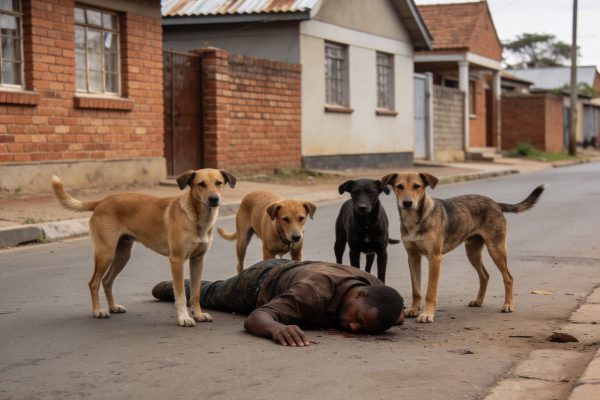
HARARE — Residents of Southerton are coming to terms with a harrowing loss after a 39-year-old man was attacked and killed by four dogs while walking along a footpath in the suburb on Thursday evening.
The Zimbabwe Republic Police (ZRP) identified the deceased as Malcom Takudzwa Muzavazi, who was killed on 24 September 2026 between 6pm and 6:30pm. The attack took place on a path running between the durawall of the ZESA Holdings property and a car sale yard.
According to police, the animals involved were a male Belgian Malinois and three crossbreeds of Belgian Malinois and German Shepherd. The dogs were reportedly in the care of a private security guard who had let them out of their kennels to be fed.
Two arrests as investigations continue
Two people have been taken into custody in connection with the death. Police named them as Mannex Svova, 21, the security guard on duty, and Itai Tamirepi, 43, a co-owner of the car sale where the dogs were kept.
Both are said to be assisting police with investigations. The ZRP has not released further details on how the animals came to be on the footpath or whether the kennels were secured at the time.
For families in Southerton and neighbouring industrial areas, the death has revived long-standing concerns about how privately owned guard dogs are handled in spaces that the public uses daily. Footpaths between industrial premises, car sales and residential blocks are frequently patrolled by animals bred for security work, and the boundary between a guarded yard and a public route is often a single wall or gate.
Why dog attacks keep happening in Harare
Attacks of this kind rarely happen without warning signs, yet they continue to claim lives in and around the capital. Belgian Malinois and German Shepherd crosses are popular with security operators and business owners because of their speed, bite strength and strong territorial instincts. Those same traits make them dangerous when handling is poor, when kennels are opened without proper control, or when animals are allowed to roam near public paths.
Veterinary and animal welfare specialists have repeatedly argued that the risk is manageable. Secure enclosures, trained handlers, warning signage and clear separation between animal runs and pedestrian routes all reduce the chances of an attack. Where those measures are missing, pedestrians — particularly early-morning commuters, schoolchildren and vendors — carry the risk.
The case also raises questions about accountability. Owners and handlers can face criminal charges where negligence leads to death or serious injury, and victims’ families may pursue civil claims for damages. Establishing who had custody of the animals, and whether reasonable care was exercised, is expected to be central to the Southerton investigation.
Community unease in the wake of the attack
Word of the death spread quickly across Southerton and nearby suburbs, with residents pointing to the footpath as a route used by workers and residents moving between the industrial belt and residential streets. Some have called for tougher inspection of premises that keep multiple dogs, arguing that enforcement is currently reactive rather than routine.
Others have urged caution against blanket condemnation of security dogs, noting that many businesses rely on them legitimately and that responsible owners face few problems.
What is not in dispute is the human cost. Muzavazi’s death leaves a family in mourning and a community asking how a routine walk home ended in a fatal mauling.
What next
Police are continuing their investigations and have appealed to anyone with information about the movements of the dogs that evening to come forward. The two arrested men are expected to appear in court once investigations are complete.
For Harare residents, the tragedy is a reminder to report aggressive or loose dogs to the relevant authorities, to avoid footpaths that run alongside premises keeping guard animals, and to press for inspection of yards where dogs are kept close to public walkways.
As Southerton mourns, the question hanging over the suburb is a straightforward one: how many more footpaths have to become killing grounds before the rules governing dangerous dogs are properly enforced?