President Emmerson Mnangagwa has paid tribute to the late Vice President and national hero Cde Simon Vengai Muzenda, portraying him as a fearless freedom fighter whose record on national unity and rural upliftment still has relevance for Zimbabwe more than two decades after his death.
The President’s message places Muzenda among the generation of liberation leaders whose contribution, he argues, should be studied rather than merely remembered at commemorations. According to the tribute, Muzenda’s insistence on holding the country together and on taking development to the countryside remains a standard against which current programmes can be measured.
A life spent in the liberation struggle
Muzenda, who was born in Gutu in Masvingo Province in 1922, was among the founding figures of the Zimbabwe African National Union and spent years in exile and detention as the armed struggle intensified. He is remembered as one of the nationalists who kept the movement intact during its most fractious periods, operating from Zambia and later Mozambique as the war against colonial rule spread across the country.
At independence he moved into government, serving first as Deputy Prime Minister and later, from 1987, as one of Zimbabwe’s two Vice Presidents — a position he held alongside the late Joshua Nkomo until his death on 20 September 2003.
The ‘Soul of the Nation’
Muzenda’s political durability earned him a reputation as a bridge-builder inside Zanu PF and beyond. He was widely referred to as the ‘Soul of the Nation’, a title that reflected his role in mediating disputes and in carrying the party’s message into rural communities where he was best known.
President Mnangagwa’s tribute leans heavily on that image, presenting Muzenda as a leader who preferred persuasion and grassroots contact to confrontation. It is a characterisation that resonates with the ruling party’s current emphasis on internal cohesion and on reconnecting with rural voters.
Rural development as a monument
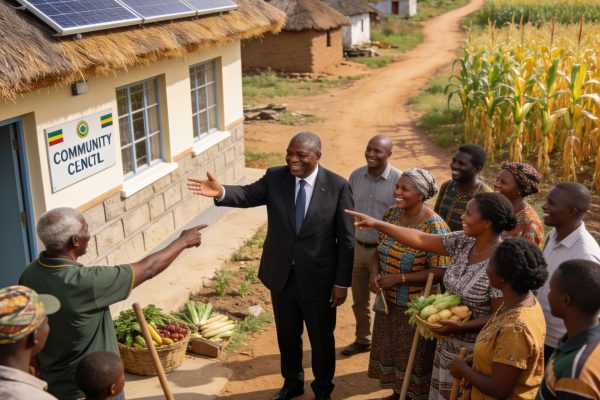
Much of the tribute focuses on Muzenda’s attachment to rural development — schools, clinics, roads and agricultural support for smallholder farmers in Masvingo and beyond. The President argues that this focus was not sentimental but strategic, on the basis that Zimbabwe’s economy and its food security stand or fall on what happens in the countryside.
That argument carries weight as the Government rolls out irrigation, dam construction and agricultural mechanisation programmes aimed at reducing dependence on rain-fed farming. Officials have repeatedly linked such projects to the vision of the country’s founding leaders.
Key themes in the tribute
- Muzenda’s role as a founding nationalist and long-serving Vice President
- His reputation as a unifying figure within Zanu PF and in national politics
- His emphasis on rural infrastructure and smallholder agriculture
- The call for younger Zimbabweans to study the liberation generation’s record
Unity as a governing principle
The President’s message also returns to a familiar theme: that unity is not a slogan but a condition for stability and investment. He credits Muzenda with helping to hold the country together during the difficult years that followed independence, including the period of reconciliation after the disturbances in Matabeleland and the Midlands.
Critics of the governing party have long argued that tributes of this kind are used to burnish the present by association with the past. Supporters counter that the liberation generation’s emphasis on cohesion and rural investment offers a practical template at a time when Zimbabwe is courting foreign investment and rebuilding its agricultural base.
Why the message matters now
Commemorations of Muzenda come as Zanu PF manages succession questions, a cost-of-living squeeze and pressure to deliver visible development in the provinces. Invoking a figure remembered as a moderate and a ruralist allows the President to speak to party unity and to the countryside in a single message.
For ordinary Zimbabweans, the more immediate test will be whether the rhetoric translates into clinics that are stocked, roads that are passable and farmers who can sell what they grow. That, more than any plaque or anniversary speech, is likely to determine how Muzenda’s legacy is judged by the generation that never knew him.
Whatever the political reading, the tribute ensures that Muzenda’s name remains part of the national conversation — not only as a hero of the liberation war, but as a yardstick for the promises made to rural Zimbabwe.