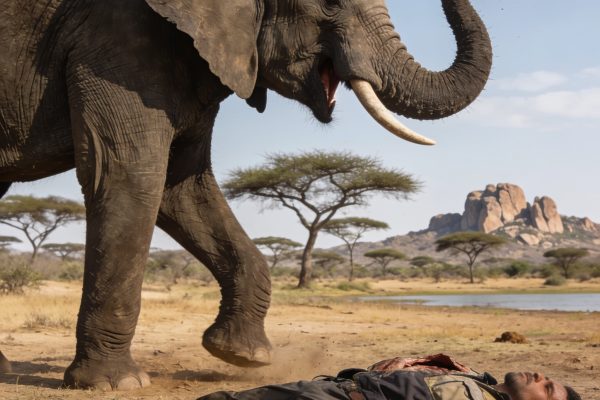
A man has been killed by an elephant at Spurwing Island, a well-known wildlife and fishing destination on Lake Kariba, in the latest fatal encounter between people and wild animals in Zimbabwe.
The Zimbabwe Parks and Wildlife Management Authority (ZimParks) confirmed the attack, which took place at approximately 5:20am on 18 September 2026. Further details on the victim and the circumstances leading up to the encounter were not immediately available.
The death adds to a growing tally of injuries and fatalities linked to wildlife across the country, and has renewed attention on how Zimbabwe manages the increasingly fraught boundary between protected animals and the communities living alongside them.
A problem that keeps growing
Human-wildlife conflict is not a new phenomenon in Zimbabwe, but its frequency and severity have climbed steadily over the past decade. Elephants, crocodiles, lions, buffalo and hyenas account for the bulk of dangerous encounters, with elephants responsible for a large share of fatalities.
Several factors are converging to push animals out of parks and into farmland, fishing camps and settlements:
- Habitat pressure: Growing human settlement, farming and infrastructure along wildlife corridors has narrowed the routes animals use to move between feeding and watering areas.
- Climate stress: Repeated dry spells reduce grazing and water inside protected areas, forcing herds to range further in search of both.
- Population density: Zimbabwe carries one of the largest elephant populations in southern Africa, with numbers widely estimated to exceed the ecological carrying capacity of the parks that host them.
- Competition for water: Shoreline settlements, irrigation schemes and fishing camps along the Zambezi and Lake Kariba bring people into direct contact with animals that depend on the same water sources.
Kariba and the Zambezi corridor in the spotlight
The Lake Kariba basin, including islands such as Spurwing, sits at the centre of Zimbabwe’s human-wildlife conflict map. The shoreline supports tourism lodges, fishing operators, subsistence farmers and communal settlements, while the water body itself hosts substantial elephant, hippo and crocodile populations.
Incidents in the area tend to spike in the early hours of the morning and at dusk, when animals move most actively and visibility for people is poor — a pattern consistent with the timing of the Spurwing attack.
Compensation, prevention and community programmes
ZimParks works with rural district councils, the CAMPFIRE programme and conservation partners on measures intended to reduce conflict, including problem animal control units, electric fencing around fields, chili-fence deterrents and community awareness campaigns.
Compensation for victims of wildlife attacks remains a persistent grievance. Communities living with dangerous animals argue that payouts are slow, limited in scope and rarely match the losses suffered by affected families, which in turn erodes tolerance for conservation efforts.
Staying safe in wildlife areas
Authorities routinely advise people in wildlife zones to avoid walking at night or in thick bush, to travel in groups where possible, to keep livestock enclosures secure, and to report sightings of problem animals to ZimParks or local authorities rather than attempting to drive them off.
Tourists and visitors to lakeshore destinations are urged to follow guidance from lodge operators and park rangers, particularly around unguarded shorelines where animals come down to drink.
The Spurwing Island death is a reminder that as Zimbabwe balances conservation gains against the safety of its citizens, the cost of living beside wildlife continues to be measured in lives.